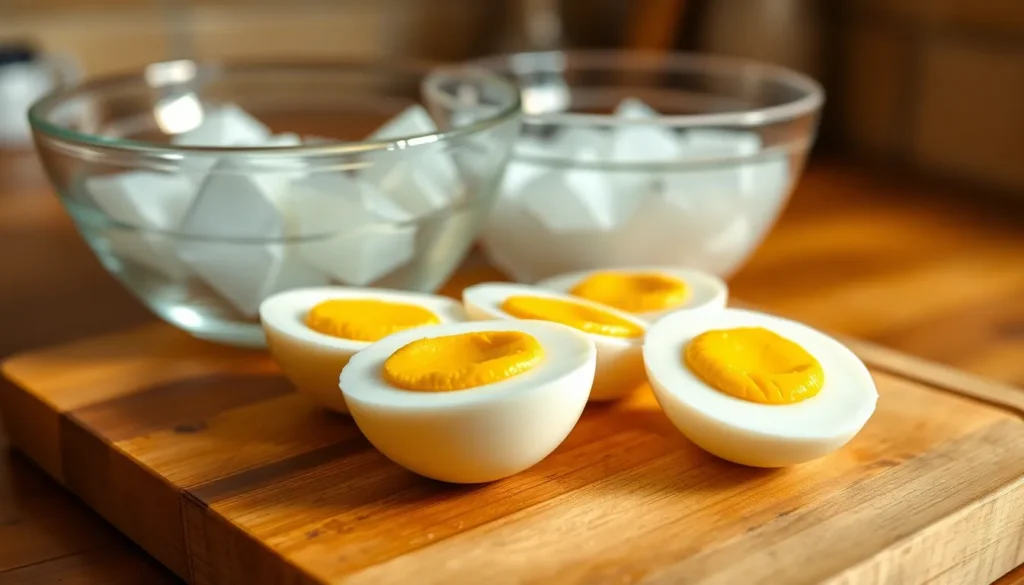
Perfecting the art of hard boiling eggs can feel like a culinary mystery. One moment, you’re staring at a pot of water, and the next, you’re left with a rubbery disaster. Fear not, egg enthusiasts! Getting that ideal hard-boiled egg is easier than you think.
Understanding Hard Boiled Eggs
Hard boiled eggs consist of eggs cooked in boiling water until the yolk and white solidify. The cooking time affects texture and doneness. Generally, a range of 9 to 12 minutes provides options for achieving desired firmness.
Cooking for 9 minutes yields a soft center, while 12 minutes delivers a fully cooked yolk. Variations in size influence cooking duration; larger eggs may require more time than smaller ones.
Starting with room temperature eggs often leads to even cooking. Placing eggs in boiling water minimizes cracking, as cold eggs may expand rapidly.
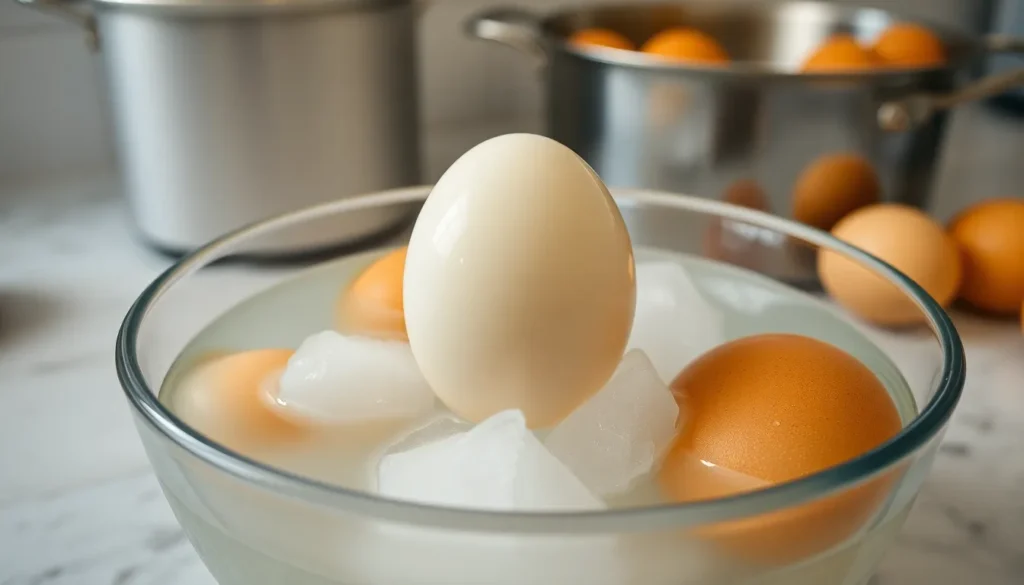
Cooling underwater halts cooking and eases peeling. Submerging eggs in ice water for about 5 to 10 minutes proves effective.
Monitoring time ensures optimal results. Temperature consistency maintains desired doneness, while variations in altitude may necessitate adjustments.
Considering methods of boiling adds to the process. Simmering strategy many use involves gentle bubbles to maintain egg structure. Still, boiling eggs creates a different texture, which some prefer.
Incorporating these tips allows for tailored cooking experiences. Beginners and seasoned cooks can recreate perfect hard boiled eggs consistently by adjusting times and methods.
Cooking Times Based on Egg Size
Cooking times vary according to egg size, affecting the final texture and firmness of hard boiled eggs. Consider the following specific guidelines for each egg size.
Medium Eggs
Medium eggs typically weigh about 44-49 grams each. For this size, boiling for 9 to 10 minutes results in a fully cooked yolk and white. Choosing this time ensures a firm, yet creamy yolk. During the cooling process, submerging medium eggs in ice water halts the cooking, maintaining the desired texture.
Large Eggs
Large eggs, weighing approximately 50-57 grams, require a cooking duration of 10 to 12 minutes. Achieving a perfect hard boiled egg involves selecting 11 minutes for a well-cooked, crumbly yolk. Resting large eggs in an ice bath after boiling enhances peeling ease and prevents overcooking.
Extra-Large Eggs
Extra-large eggs, weighing around 58-64 grams, necessitate a longer cooking time of 12 to 14 minutes. For optimal results, cooking extra-large eggs for 12 minutes yields a tender yet fully cooked yolk. Similar to medium and large eggs, placing them in ice water is crucial to stop the cooking process and firm up the whites.
Methods for Boiling Eggs
Different methods exist for boiling eggs, each offering unique benefits. Utilizing these techniques can lead to consistently excellent results.
Stovetop Method
The stovetop method remains a popular choice for boiling eggs. Start by placing eggs in a single layer at the bottom of a pot. Cover the eggs with enough water, ensuring it surpasses the eggs by at least an inch. Bring the water to a rapid boil over high heat. Upon reaching a boil, remove the pot from the heat and cover it. For medium eggs, let them sit in the hot water for 9 to 10 minutes. Larger eggs require a sitting time of 10 to 12 minutes, with 11 minutes resulting in a desirable crumbly yolk. After the appropriate time, transfer the eggs to an ice bath. This quick cooling process halts cooking and preserves the ideal texture.
Instant Pot Method
The Instant Pot method simplifies the boiling process significantly. Place a steamer basket inside the pot, along with one cup of water. Arrange the eggs on the steamer basket, ensuring they don’t touch the water. Secure the lid and set the pressure valve to sealing. Cook on high pressure for five minutes, then release the pressure quickly. Once the pressure is dropped, transfer the eggs to an ice bath. The result creates perfectly cooked hard boiled eggs with minimal effort. Adjust cooking time as needed for different egg sizes to maintain consistent quality.
Timing and Doneness
Achieving the right timing for boiling eggs ensures perfect doneness. Understanding the differences between soft boiled and hard boiled eggs helps clarify desired outcomes.
Soft Boiled vs. Hard Boiled
Soft boiled eggs cook for a shorter duration, resulting in a runny yolk and tender whites. Soft boiled eggs typically require 4 to 6 minutes in boiling water. For hard boiled eggs, longer cooking times, usually between 9 to 14 minutes, solidify both the yolk and white. Medium eggs reach a creamy yolk in 9 to 10 minutes, while 11 minutes provides a well-cooked large egg. Exact cooking times depend on egg size, with extra-large versions needing 12 to 14 minutes for a tender yolk.
Testing for Doneness
Testing for doneness involves a few reliable methods. An initial approach includes gently spinning the egg; if it spins smoothly, it’s likely hard boiled. Cracking the shell slightly also provides insight; a firm white and yolk usually indicate complete cooking. Another method involves carefully removing one egg from the pot after specified cooking time and assessing the yolk’s consistency for the desired firmness. Adjusting times based on altitude or egg size further ensures consistent results in achieving perfect hard boiled eggs.
Tips for Perfect Hard Boiled Eggs
Achieving perfect hard boiled eggs involves specific techniques. Start with room temperature eggs to prevent cracking during cooking. Place the eggs in a pot and cover them with water, ensuring the water level is at least an inch above the eggs. Bring the water to a boil over medium-high heat. Once boiling, reduce the heat and let the eggs simmer for the desired time, such as 9 to 12 minutes based on egg size.
Monitor the cooking time closely. Medium eggs require 9 to 10 minutes for a firm yet creamy yolk, while large eggs need 10 to 12 minutes for a well-cooked, crumbly yolk. Extra-large eggs take a bit longer; 12 to 14 minutes works best, with 12 minutes yielding a tender yolk.
Cooling eggs immediately in an ice bath stops the cooking process. Transfer boiled eggs promptly to an ice bath and let them sit for at least five minutes. This step makes peeling easier and improves the final texture.
Consider experimenting with different boiling methods. The stovetop method provides control over cooking time, while the Instant Pot method simplifies the process using high pressure cooking. Both methods yield excellent results when following the recommended times.
Testing for doneness also helps. Spinning the egg can indicate its readiness; a stable egg typically signals that it’s fully cooked. Cracking the shell slightly allows checking the yolk’s consistency without fully removing the shell.
Using these tips leads to consistently perfect hard boiled eggs, satisfying both novice cooks and culinary enthusiasts.
Perfecting hard boiled eggs is an attainable goal for anyone willing to follow a few simple guidelines. By understanding the ideal cooking times for different egg sizes and employing techniques like starting with room temperature eggs and using an ice bath, anyone can achieve the desired texture.
Experimenting with various boiling methods can also add convenience to the process. Whether opting for the traditional stovetop or the Instant Pot, the right approach can lead to consistently satisfying results. With these strategies in hand, culinary enthusiasts can confidently create hard boiled eggs that meet their preferences every time.